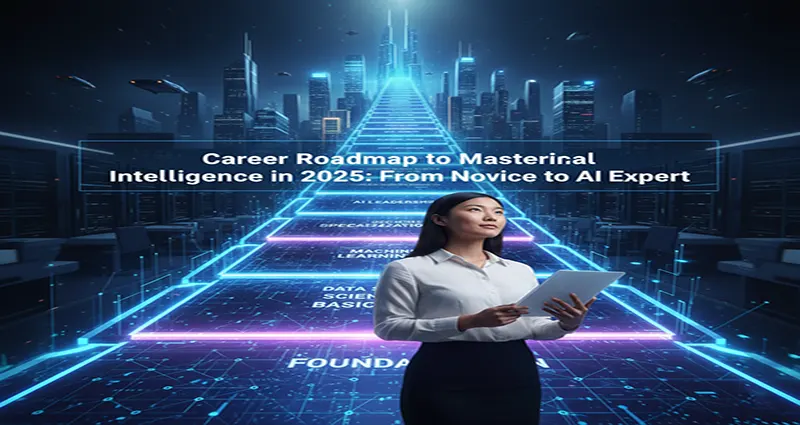
Mastering AI: A Beginner’s Guide for Non-Programmers

Artificial Intelligence (AI) is no longer a technology solely for coders and data scientists. Today, it’s a vital skill for professionals in every field, and you can achieve AI fluency without writing a single line of code. This guide provides beginners and non-programmers with a clear roadmap to understanding, using, and mastering AI tools.

1. Get Acquainted with the AI Landscape

The first step in mastering AI is building a conceptual foundation. You don’t need to know how the engine works, but you should understand what the car can do and how to drive it safely.

  • Understand Key Concepts: Learn the difference between terms like Artificial Intelligence (AI), Machine Learning (ML), and Deep Learning. Crucially, get familiar with Generative AI (like ChatGPT, Claude, and Gemini), which is the most accessible entry point for non-programmers.
  • Identify Capabilities and Limitations: Understand what AI realistically can and cannot do. AI
Read More ...
The AI Expert Roadmap: A Step-by-Step Guide to Mastery

Artificial Intelligence (AI) is the most transformative technology of the 21st century. Becoming an AI expert is a challenging but immensely rewarding journey that demands a blend of strong theoretical knowledge, practical coding skills, and continuous learning.

This step-by-step roadmap is designed to guide aspiring AI professionals, from novice to expert.

Step 1: Build an Unshakeable Foundation (The First 6-12 Months)

Expertise in AI is built on a solid academic and technical bedrock. Do not skip these fundamentals.

A. Master the Mathematics

AI algorithms are fundamentally mathematical concepts. A strong understanding is crucial for optimizing models and troubleshooting errors.

SubjectWhy it Matters for AI
Linear AlgebraEssential for understanding how data is represented, transformed, and processed (vectors, matrices, neural networks).
CalculusKey to optimization algorithms like Gradient Descent, which AI models use to learn and minimize error.
Probability & StatisticsNecessary for data analysis, model evaluation, uncertainty quantification,
Read More ...
The Best Online Courses to Learn AI and Machine Learning: A Comprehensive Guide

The fields of Artificial Intelligence (AI) and Machine Learning (ML) are rapidly evolving, creating high-demand career paths and transforming industries worldwide. Whether you’re a complete beginner looking to understand the fundamentals or an experienced developer seeking to specialize, a high-quality online course can provide the structured knowledge and practical skills you need.

Here is a curated list of some of the best and most highly-regarded online courses and specializations for learning AI and Machine Learning, categorized by proficiency level and focus.

1. Top-Rated Foundational Courses (Beginner to Intermediate)

These courses are excellent starting points, offering a robust introduction to the core concepts of ML and AI.

Course/SpecializationProviderFocusKey Highlights
Machine Learning SpecializationDeepLearning.AI (on Coursera)Foundational ML, Supervised/Unsupervised LearningTaught by Andrew Ng, a pioneer in the field. Focuses on practical application using Python, NumPy, and scikit-learn.
AI For EveryoneDeepLearning.AI (on Coursera)Non-Technical AI LiteracyIdeal for
Read More ...
The Master Plan: How to Master Artificial Intelligence From Scratch

Artificial Intelligence (AI) is the driving force behind modern technology, and its mastery is one of the most sought-after skills today. While the journey may seem intimidating, with a structured approach, anyone can master AI from the ground up. This article provides a clear roadmap to take you from a complete beginner to a proficient AI developer.

1. Build the Foundational Pillars: Programming and Mathematics

Before diving into complex algorithms, you need a strong, unshakeable foundation in the core technical prerequisites.

Programming: The Language of AI

The primary language of AI is Python. It’s favored for its simple syntax and a vast ecosystem of libraries that handle complex computations.

  • Master the Basics: Start with Python fundamentals: variables, data structures (lists, dictionaries), control flow (loops, conditionals), and functions.
  • The Ecosystem: Get comfortable with the essential Python libraries for AI:
    • NumPy for efficient numerical operations and array manipulation.
    • Pandas for data
Read More ...
Legitimate Online Jobs Hiring with No Experience Needed

In today’s digital age, finding legitimate online jobs that require no prior experience can be a game-changer for those looking to enter the world of remote work. The opportunity to work from the comfort of your home, on your own schedule, is now more accessible than ever. If you are someone who is eager to kickstart your career or earn some extra income, here are some legitimate online jobs hiring individuals with little to no experience required.

1. Virtual Assistant

Becoming a virtual assistant is a popular choice for those seeking online work without prior experience. As a virtual assistant, you will assist businesses or entrepreneurs with various tasks, such as email management, scheduling appointments, or social media management. Many companies provide training and resources to help you succeed in this role.

2. Freelance Writing

If you have a way with words, freelance writing might be the perfect fit for … Read More ...